If you are a distributor thinking about whether to bring decoration in-house or hand it to a contract decorator, you do not need another article telling you outsourcing is always the right call. You need an honest comparison, because the truth is that the right answer depends on your volume, your capital, and how much control actually matters for what you sell.
This is that comparison. Control, cost, capacity, and risk on both sides, including the cases where keeping decoration in-house genuinely makes more sense.
Contract Decorator vs In-House Decoration: What Changes
Before comparing the two paths, it helps to be clear on what actually changes. Right now, if you outsource, your job is sales, client management, and coordination. Production happens somewhere else, on someone else’s equipment, with someone else’s staff.
Bringing decoration in-house means all of that becomes your responsibility too. You are no longer just managing a client relationship. You are running a production floor, whether that is one embroidery machine in a back room or a full screen printing setup with several employees.
That shift touches everything else in this comparison, so it is worth having clearly in mind before weighing the details.
Production Control: Contract Decorator vs In-House Print Shop
This is the strongest argument for keeping decoration in-house, and it is a real one. When production happens under your own roof, you decide the schedule. You decide how a rush order gets prioritized. You catch a color or placement issue the moment it happens instead of finding out after a shipment arrives.
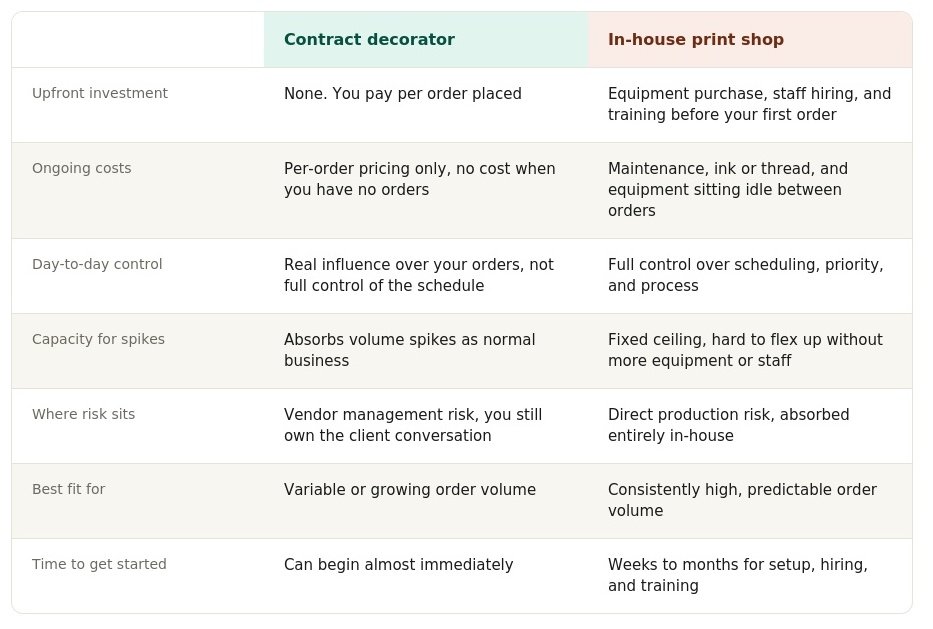
A contract decorator, even a good one, is still a separate business making its own scheduling decisions across many accounts. You get real influence over your own orders, but not the same day to day control you would have watching production happen in your own building.
Where this control matters most: highly specialized decoration work that is core to your brand identity, or client relationships where you have promised a level of hands-on customization that only makes sense if you are the one doing it.
Where it matters less than people assume: standard runs of common decoration methods, where a contract decorator’s own quality control process, done well, catches the same issues you would catch yourself.
Cost Comparison: Contract Decorator vs In-House Equipment
This is where a lot of the decision quietly gets made, whether or not anyone says so out loud.
Bringing decoration in-house is not just buying a machine. It is buying the machine, then finding and training staff who can run it well, then maintaining it, then absorbing the cost of that equipment sitting idle between orders. Screen printing setups, embroidery machines, and DTF or DTG equipment all have real purchase costs, plus ongoing costs that do not show up until you are a few months in: ink, thread, replacement parts, and the staff hours spent on upkeep instead of production.
A contract decorator removes almost all of that. You are paying per order, not carrying fixed costs whether or not you have work to fill the equipment that month. For a distributor without steady, predictable volume, that difference alone often settles the decision.
The honest exception: if your order volume is high enough and consistent enough, the math can flip. Enough steady volume eventually makes owned equipment cheaper per unit than paying a decorator on every order. The question is whether you actually have that volume today, not whether you expect to reach it eventually.
Order Capacity: Contract Decorator vs In-House Production Limits
Order volume in this industry is rarely flat. A single client’s event, a seasonal spike, or an unexpected large order can multiply your normal volume overnight.
In-house production has a ceiling. One embroidery machine can only run so many pieces in a day, no matter how badly you need more. When a spike exceeds your in-house capacity, you are stuck choosing between turning down business or scrambling to find a partner to absorb the overflow, usually at the worst possible moment to be starting that relationship.
A contract decorator with real capacity absorbs that spike as a normal part of doing business, not an emergency. This is one of the clearest, most practical reasons distributors bring on a contract decorator even after already investing in some in-house equipment: not to replace it, but to have somewhere to send the orders that would otherwise break their own capacity.
Risk and Responsibility: Contract Decorator vs In-House Decoration
This part often gets missed in the in-house versus outsource conversation, so it is worth being direct about it.
If something goes wrong with an in-house order, the mistake and the fix both happen inside your own walls. You have full visibility, but you also absorb the entire cost of it directly, in time, materials, and staff hours pulled off other work to fix it.
If something goes wrong with an outsourced order, your contract decorator absorbed the direct production cost, but you are still the one explaining it to your client, because the client relationship was always yours to protect. The risk does not disappear when you outsource. It changes shape, from direct production risk to vendor management risk.
Neither version of that risk is automatically better. It depends on which one you are better equipped to manage, direct oversight of your own floor, or careful selection and ongoing management of a decoration partner you trust.
Why Most Distributors Choose a Contract Decorator
When you weigh control, cost, capacity, and risk side by side, a clear pattern shows up for most distributors: a contract decorator removes the capital risk and the operational burden of running production, without taking away the thing that actually matters, ownership of the client relationship.
Unless your volume is already high and steady enough to make owned equipment pay for itself, or decoration itself is the exact skill your brand is built around, the math tends to favor working with a contract decorator. Lower upfront cost. No idle equipment eating margin between slow months. Capacity that grows and shrinks with your business instead of a fixed ceiling you have to staff around.
The distributors most likely to regret going in-house are the ones who did it before their volume was steady enough to justify it, then found themselves carrying equipment costs through slow months that a contract decorator would have simply absorbed as “no orders this month.”
The exceptions in the section above are real, and worth taking seriously if they describe your business. But for most distributors deciding today, a contract decorator is the lower-risk starting point, even if you revisit the decision again once your volume grows.
Why a Contract Decorator Is Worth Trying First
If you are still weighing this, the case for starting with a contract decorator is simple: it costs you almost nothing to test whether the model works for your business, and it is fully reversible if it doesn’t. Bringing decoration in-house is a much harder decision to walk back once the equipment is bought and the staff are trained.
Want to understand the relationship first? Read What a Contract Decorator Does for a Promotional Product Distributor to see exactly how it works before you commit either way.
Ready to see what it looks like for your volume?