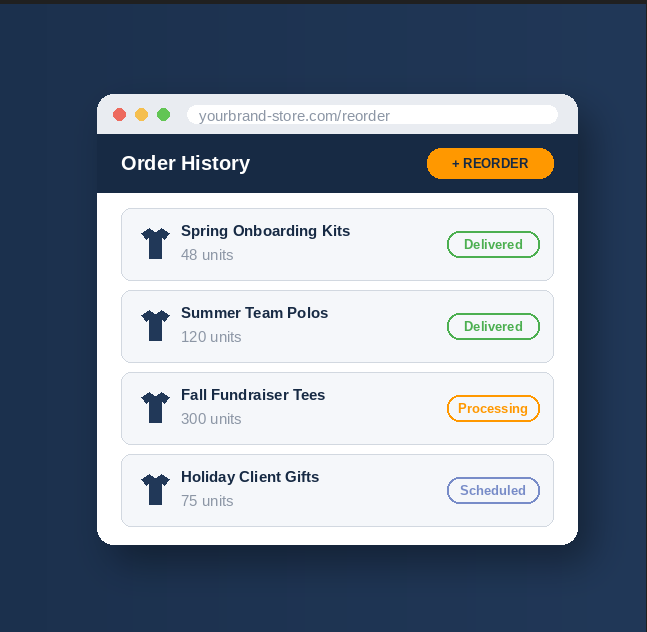
Webstore automation replaces the manual quote-and-approval cycle with a self-service system buyers use on their own, turning occasional orders into standing reorder programs. For apparel distributors and B2B merchandise partners, that shift is one of the few retention levers a business fully controls, rather than something dependent on how a buyer happens to feel about the brand. Here’s what it actually changes operationally, and where the retention argument holds up versus where it’s reasoning rather than proof.
What Does Webstore Automation Mean for a Distributor?
Webstore automation, in this context, isn’t about replacing a sales relationship with software. It means moving the repetitive, low-judgment parts of ordering, catalog lookup, pricing, size and quantity selection, approval routing, off a person’s inbox and onto a self-service system the buyer controls directly.
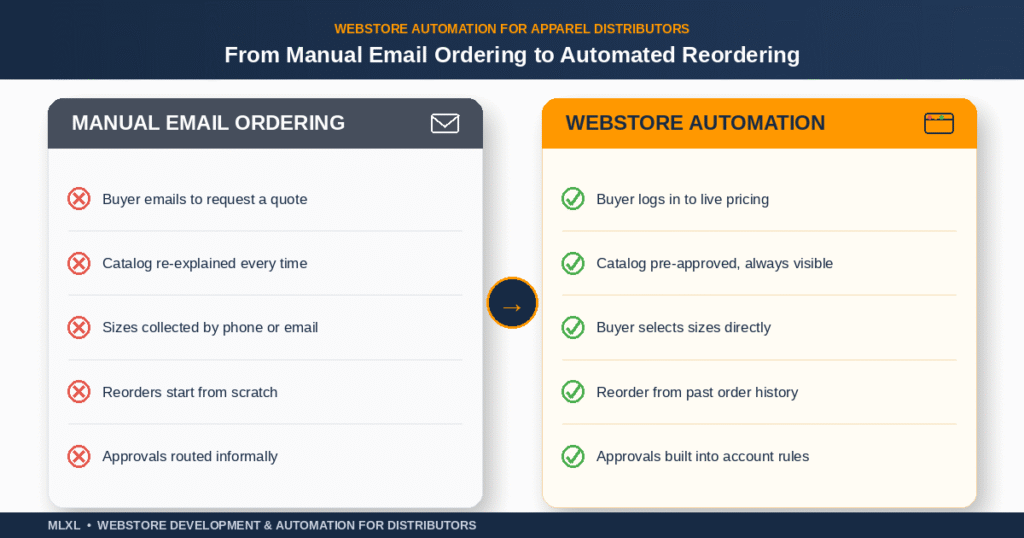
| Manual process | Automated through a webstore |
| Buyer emails or calls to request a quote | Buyer logs in and sees live pricing and availability |
| Someone manually re-explains the catalog each time | Catalog is pre-approved and visible on demand |
| Sizes and quantities collected by phone or email | Buyer selects sizes and quantities themselves |
| Reorders require starting the request from scratch | Order history makes reordering a repeat of a past order |
| Spending limits enforced by asking first | Budget caps and approval routing can be built into account permissions |
None of this requires guessing at a buyer’s intent. It just removes the steps that exist only because there was no self-service option before.
Read our Blog on Brand Experience and How does it Build Client Retention
Why Automated Reordering Is a Natural Fit for Apparel and Merchandise Program
Apparel distributors deal with demand that already repeats on a predictable schedule: onboarding kits for new hires, seasonal team gear, annual fundraiser merchandise, event-driven orders tied to a specific date every year. None of this is a one-off purchase pattern, it’s a recurring need that currently gets re-requested manually each time it comes up.
A webstore doesn’t create that recurring demand. It removes the friction sitting between a demand that already repeats and an order that actually gets placed on time. When a buyer has to re-request a quote every single cycle, some of that repeat demand gets delayed, shrunk, or lost to a competitor who made reordering easier. When the catalog and pricing are already sitting there waiting, the repeat order is a few clicks instead of a renegotiation.
This is a reasonable argument for why automation matters more for apparel and merchandise programs specifically, not a claim that it will increase any individual business’s reorder rate by a specific percentage. No source available supports a precise figure for that, so this is presented as mechanism, not measured outcome.
Client Retention for Distributors: The Levers You Actually Control
Retention, a buyer continuing to order rather than switching suppliers, isn’t something a business can engineer directly. What it can engineer are the conditions that make staying easier than switching:
- Consistency: the same catalog, pricing, and process every time, regardless of order size or who placed it
- Speed: self-service removes the wait for a human to respond to routine requests
- Clarity: visible, current pricing and availability instead of “let me check and get back to you”
- Coherence: the ordering process, the product, and the fulfillment all reflecting one business, not three disconnected experiences
A buyer weighing whether to reorder from the same distributor or shop around tends to default to whichever option requires less effort. A webstore is a direct way to make staying the lower-effort option. Whether that translates into a measurable retention gain for any specific business is something that needs to be tracked with that business’s own order data over time, not assumed from general reasoning.
What Automation Changes at Each Stage of the Reorder Cycle
| Stage | Without automation | With a branded webstore |
| Buyer decides to reorder | Has to remember what was ordered last time and re-request it | Order history shows exactly what was ordered before |
| Pricing and availability | Re-confirmed manually each time | Visible immediately, no back-and-forth |
| Approval (for larger orgs) | Routed informally through email chains | Can be built into account permissions and spending limits |
| Placing the order | A new quote request, essentially starting over | A repeat of a previous order, placed directly |
| Fulfillment | Manually scheduled once the quote is confirmed | Triggered as soon as the order is placed |
Each stage that moves from manual to self-service removes one more reason a buyer might delay, shrink, or abandon a reorder.
Frequently Asked Questions
How does webstore automation help a distributor’s reordering process?
It helps by replacing manual quote requests and email-based ordering with a self-service system where buyers see live pricing, select their own sizes and quantities, and place repeat orders directly from their order history.
Does automating the ordering process guarantee better client retention?
No single source confirms a specific retention improvement from ordering automation. What it does is remove friction from the reordering process, which is a reasonable, controllable lever, not a guaranteed outcome, and should be tracked against a business’s own numbers over time.
Is webstore automation only useful for large distributors with many clients?
No. Any apparel distributor or merchandise partner with recurring order patterns, onboarding kits, seasonal gear, annual fundraiser merchandise, benefits from removing the re-request friction, regardless of overall size.
Can approval workflows and spending limits be built into a branded webstore?
Yes, account-based permissions and budget caps are a standard feature of most webstore platforms, allowing larger buying organizations to route approvals without reverting to manual email chains.
Talk to MLXL About Automating Your Reorder Process
If your repeat business is still running through manual quote requests, the friction in that process is costing you reorders you’d otherwise keep. MLXL builds branded webstores with order history, approval routing, and self-service reordering built in, for distributors who want repeat business to stay easy to capture.