Ordering custom apparel and merchandise typically follows a familiar pattern: an email request, a size sheet, a quote, a wait, and a follow-up email the next time the need arises. For organizations that place these orders only occasionally, that process is manageable. For organizations that place them repeatedly, it becomes a recurring drain on staff time and budget.
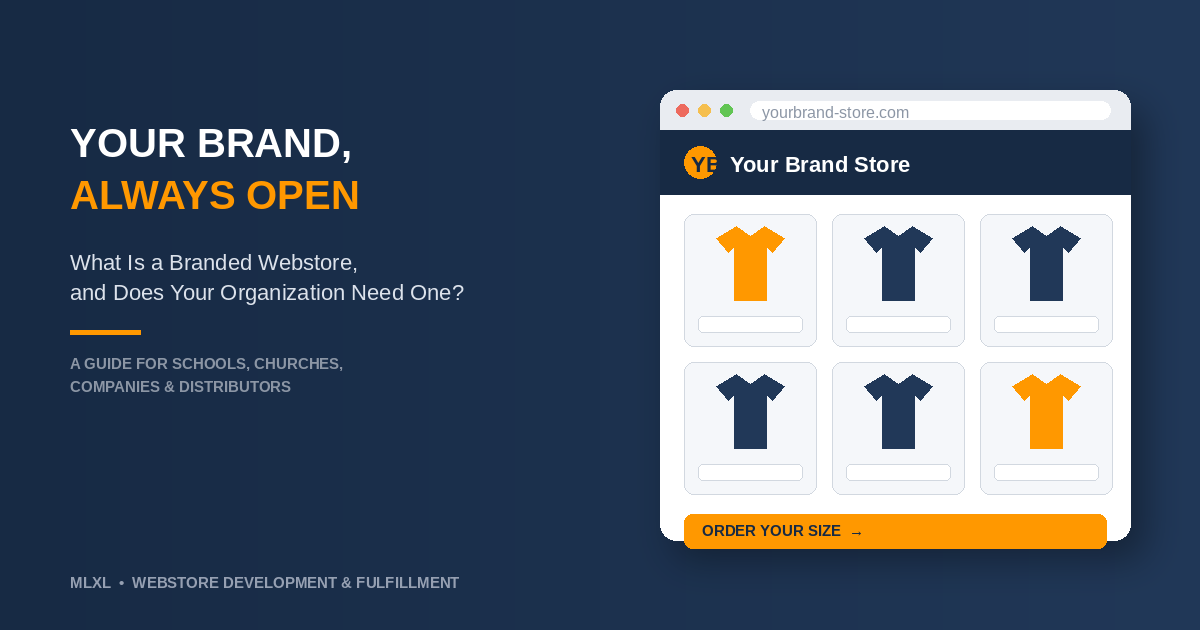
A branded webstore, also known as a company store, is a custom-branded online shop where an organization’s staff, members, students, or clients can order approved merchandise on demand. Instead of initiating a new order each time, users log in, select their items and sizes, and check out directly. This guide explains what a branded webstore is, who typically needs one, and how to evaluate whether your organization has reached that point.
What Is a Company Store? A Branded Webstore Explained
A branded webstore functions less like a single transaction and more like a standing retail operation built around one organization’s identity.
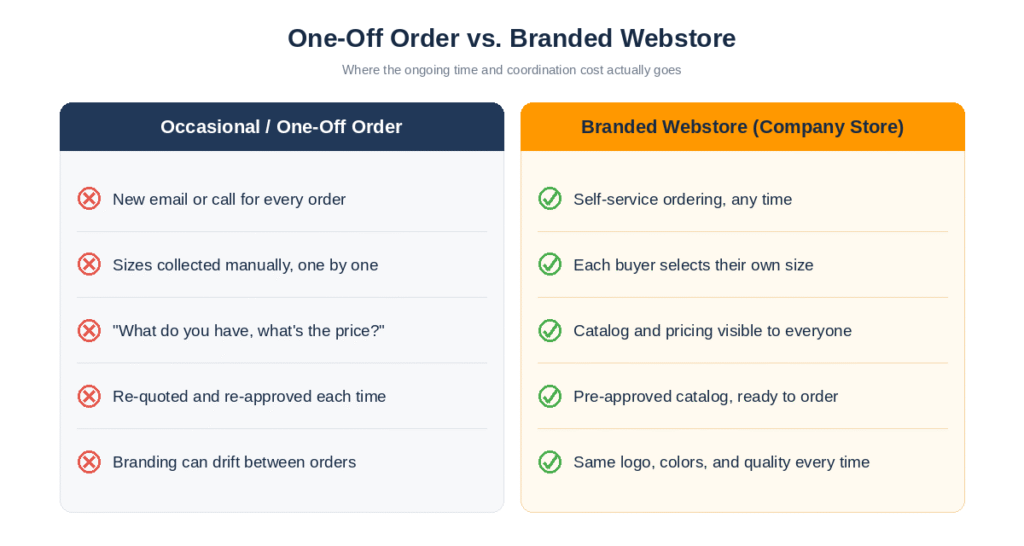
A one-off order is a single request fulfilled once. A company store is a persistent, always-available storefront stocked with a pre-approved product catalog. The core components typically include:
- A curated product catalog: only items the organization has approved, in its own colors and logo
- A dedicated storefront: public-facing (a school’s spirit wear shop) or restricted to a defined group (an employee-only ordering portal)
- Individual ordering: each user selects their own size and quantity, rather than one administrator compiling a group order manually
- A direct link to production: orders route to fulfillment without manual re-entry
A company store is not a general-purpose ecommerce site selling to the public. It is a private or semi-private ordering platform built specifically around one organization’s brand and its people.
Who Uses a Branded Webstore or Online Merchandise Store?
Organizations across a range of sectors rely on a dedicated online merchandise store to manage recurring apparel and merchandise needs, including:
- Distributors managing multiple clients: organizations that already serve several of the groups above and want to give each client a dedicated ordering hub rather than managing every order through direct back-and-forth
- Schools: spirit wear, athletic uniforms, and fundraising merchandise tied to sports seasons and school events
- Churches and nonprofits: event apparel, volunteer gear, and fundraising merchandise released in defined ordering windows
- Corporate HR departments: onboarding kits and employee apparel that new hires need on day one
- Clubs, leagues, and event organizers: merchandise tied to a specific season, tournament, or event
Signs You Need a Custom Merchandise Store
A single bulk order remains the right solution when the need is genuinely one-time. The signal that a more permanent solution is warranted is typically a pattern rather than a single event. Common indicators include:
- The same order recurs on a predictable cycle. Onboarding kits for new hires, seasonal team gear, or fundraiser merchandise that repeats every few months indicates an informal program already exists, without the infrastructure to support it efficiently.
- Staff time is consumed by manual coordination. Collecting sizes, tracking reorders, and fielding repeated questions about availability represents administrative overhead that a self-service store eliminates.
- Buyers routinely ask what’s available and at what price. If the answer is consistently “let me check and follow up,” there is no single reference point where buyers can view current options and pricing independently.
- Brand consistency is difficult to maintain. Orders placed through different channels at different times tend to drift in color, logo placement, and quality, which is precisely what a centralized, branded catalog is designed to prevent.
What Makes an Online Store Truly Branded?
The distinction between a generic order form and a branded webstore lies in execution. A properly branded store typically includes:
- The organization’s logo, colors, and visual identity applied consistently throughout the storefront, not only on the products themselves
- A curated selection limited to approved items and colorways, eliminating the risk of off-brand orders
- The organization’s name reflected in the store’s URL or subdomain
- Consistent quality and branding across every order, since all orders route through the same approved catalog and production process
For organizations that have never had a consistent, branded presence for their merchandise, this is often the first instance of their apparel program genuinely reflecting one unified identity.
Choosing a Web Store Development Firm or Online Store Development Company
Once an organization determines a branded webstore is warranted, the next decision is who builds and maintains it.
Most branded webstores are built on established ecommerce platforms such as Shopify, customized to the organization’s branding, catalog, and ordering rules. When evaluating a web store development firm or online store development company, relevant questions include:
- Does the provider offer genuine web design for brands, or a generic template with a logo applied? A store designed around an organization’s own visual identity performs differently from an off-the-shelf theme.
- Do their online store development services extend past launch? A webstore requires ongoing updates, new product additions, and support, not a one-time build.
- Does the provider understand production as well as storefront design? Building the store addresses only half the requirement; someone must still decorate, finish, and ship what is ordered. A single provider handling both reduces the number of vendor relationships required.
Web Design for Brands: What to Expect from Retail Website Development
MLXL is a contract decorator, providing screen printing, embroidery, DTF and heat transfer services, that now also offers webstore development and maintenance. The approach is intentional: the same partner responsible for retail website development also produces what customers order through that store, consolidating decoration and fulfillment under a single point of contact rather than splitting the work between a developer and a separate decorator.
Does Your Organization Need an Online Store?
The following questions offer a starting point for evaluating whether a branded webstore is warranted for your organization:
- Does your organization place the same type of order more than once per year?
- Does a staff member currently manage sizing, ordering, or reorders manually?
- Would your organization’s people, new hires, members, students, staff, realistically use a self-service store if one existed?
- Is brand consistency currently difficult to enforce across separate orders?
- Is your organization selecting a different vendor for each order, rather than maintaining one ongoing arrangement?
Two or more affirmative answers indicate that a branded webstore is likely to reduce administrative overhead for your organization.
Frequently Asked Questions About Branded Webstores
What is a company store?
A company store is a private or semi-private online shop, branded to a single organization, where approved users order pre-approved merchandise independently, replacing the need for a new bulk order placed through email or spreadsheet each time.
Is a branded webstore the same as a standard online store?
No. A standard ecommerce store typically sells to the general public. A branded webstore is usually restricted to a defined group, such as employees, students, members, or a client’s own customers, with a catalog limited to organization-approved items
Does an organization need to hold inventory to operate a webstore?
Not necessarily. Depending on the store’s configuration, orders can be produced on demand rather than fulfilled from stocked inventory. The appropriate model depends on order volume and delivery timelines, and is best determined through a direct conversation with a provider.
How long does it take to launch a branded webstore?
Timelines vary based on catalog scope, the extent of custom design work, and the platform used. Any provider should be able to supply a project-specific timeline rather than a general estimate.
Do distributors use branded webstores as well?
Yes. A distributor serving multiple clients, such as schools, companies, and teams, can use branded webstores to give each client an independent ordering hub, formalizing a relationship that often already exists informally.
Ready to Explore a Branded Webstore for Your Organization?
Whether you’re evaluating this directly for your own organization or on behalf of a client you serve, MLXL can walk you through what a branded webstore involves, from initial design through ongoing fulfillment.
[Talk to MLXL About Your Webstore →]