
If you work in the promotional products or apparel industry long enough, you will hear the term “contract decorator” thrown around constantly, usually with the assumption that everyone already knows exactly what it means. Plenty of distributors use one every week without ever having had the model explained to them plainly.
So before anything else in this series, here is the plain version. What a contract decorator actually does, who owns what in that relationship, and where the risk sits if something goes wrong.
What is a Contract Decorator
A contract decorator is a production partner that adds the printing, embroidery, or other decoration to blank goods on behalf of someone else, without ever becoming part of that person’s client relationship. The word “contract” is doing real work in that title. It means the decorator is bound to produce exactly what was ordered, to the specification given, and then step back out of the picture.
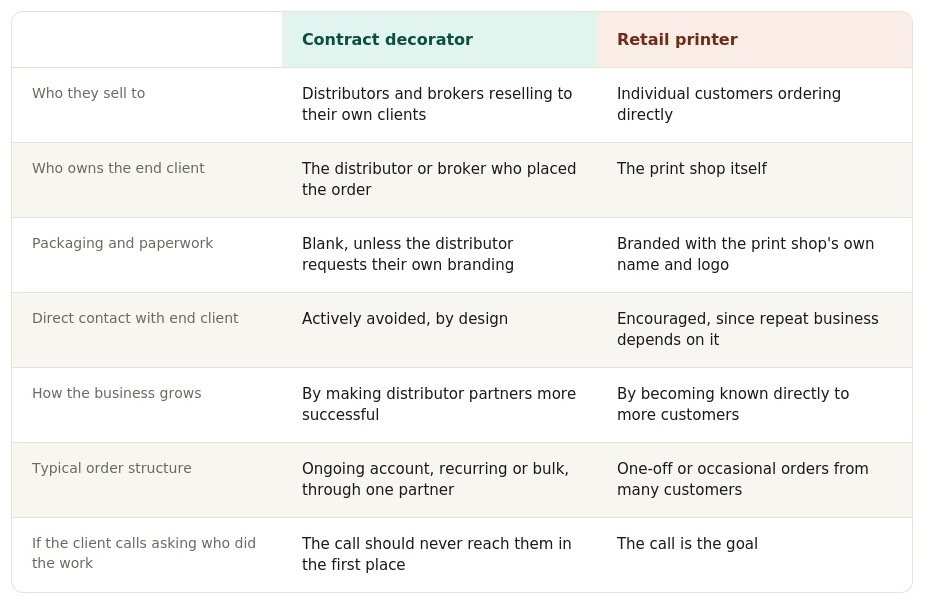
This is different from a retail print shop, which takes orders directly from whoever walks in or fills out a form on their website, and which treats the person placing the order as its own customer going forward. A contract decorator has no interest in becoming your client’s decorator. Their entire business model depends on staying invisible to that relationship.
Who Owns the Client in a Contract Decorator Relationship
In a contract decoration relationship, there are three parties, but only two relationships that matter.
The distributor owns the client. That means the pricing conversation, the sales relationship, the trust that has been built over months or years, and the responsibility for making sure the client is happy. None of that transfers to the decorator, ever, regardless of how many orders get placed.
The decorator owns production. That means turning a blank garment into a finished, decorated product that matches the spec, on the timeline promised, at the quality level expected. The decorator’s job stops there.
The client, in this structure, often does not know the decorator exists at all. That is not an accident or an oversight. It is the entire point of the model. A distributor who loses that invisibility has lost the main reason to use a contract decorator in the first place.
How the Contract Decoration Process Works, Step by Step
It helps to walk through an order the way it actually moves, because this is where a lot of the confusion about the model clears up.
A client tells the distributor what they need. Maybe it is 300 polos for a corporate event, or a run of embroidered caps for a school fundraiser. The distributor works out the pricing, timeline, and specifications with the client directly.
The distributor then sends that order to the contract decorator. This is where the decorator’s job starts. Blanks get sourced or supplied, the decoration method gets applied, whether that is screen print, embroidery, DTF, and the finished goods get quality checked.
From there, the goods either go back to the distributor to handle final delivery, or they get shipped directly to the client under blind shipping, meaning no packing slip, label, or paperwork traces back to the decorator. Either way, the client’s only point of contact through the entire process remains the distributor.
That handoff structure is the whole model in miniature. Client relationship stays with the distributor from start to finish. Production responsibility sits entirely with the decorator, for exactly as long as the order is in their hands, and not a moment longer.
Risk and Responsibility in Contract Decoration
This is the part that matters most to a distributor evaluating whether to trust a contract decorator with real client relationships.
If a decorator misses a deadline, ships the wrong quantity, or gets a color wrong, the distributor is the one who has to explain that to their client. The decorator’s mistake becomes the distributor’s problem the moment it happens, because the client does not know or care that a third party was involved. That is simply how the risk is structured in this model, and it is exactly why the choice of decorator matters as much as it does.
A serious contract decorator understands this and builds their entire operation around reducing that exposure. Tight quality control before anything ships. Clear, proactive communication if a timeline is at risk, given early enough that the distributor has options. Blind shipping executed correctly, every time, with no slip ups on paperwork. None of that is a nice bonus. It is the baseline requirement for being trusted with someone else’s client relationship at all.
Contract Decorator vs Retail Printer
It is worth being direct about this distinction, since the two get confused constantly.
A retail printer wants to be known. Their business grows by becoming the print shop a customer thinks of by name, comes back to directly, and refers other people to directly. A contract decorator wants the opposite. Their business grows by making distributors more successful, quietly, in the background, order after order.
This shows up in concrete ways. A retail printer’s packaging has their branding on it. A contract decorator’s does not, unless the distributor specifically wants their own branding included instead. A retail printer will happily take a call from your client if your client happens to find them. A contract decorator structures their entire process to make sure that call never happens in the first place.
If you are evaluating a potential partner and they seem unclear on which one they are, that is worth noticing before you send them a real order.
Contract Screen Printing and Contract Embroidery Explained
One source of confusion worth clearing up: “contract screen printing” and “contract embroidery” are not different business relationships from “contract decoration.” They are simply the specific decoration method being applied within the same contract model described above.
A good contract decorator typically offers several methods under one roof, screen printing for large simple runs, embroidery for polos and caps, DTF or DTG for detailed full color work, so that a distributor is not forced to manage separate vendor relationships depending on what a particular client order requires.
Why This Model Exists at All
The short version is that it lets a distributor offer decorated goods without ever taking on the cost, equipment, and operational complexity of running decoration in house, while still keeping full ownership of the client relationship that took real time and effort to build.
It only works, though, if the decorator on the other end of it actually respects where the line sits. That is the standard we hold ourselves to, and it is worth holding any contract decorator to the same standard before handing them a client relationship you have spent years building.
If you want to see what that looks like in practice, our Screen Printing, Embroidery, and other service pages walk through exactly how we handle production on the decorator side of this relationship.
What This Means for You
Now that the model itself is clear, the real question is what to look for when you are the one choosing a contract decorator to trust with a client relationship. That is worth its own read before you go any further.
Continue reading: How Distributors and Suppliers Can Use Contract Decorators covers exactly that, what to look for, common ways the relationship actually gets used, and the questions worth asking before you commit.
If you already know enough to start a conversation, we are glad to have it.